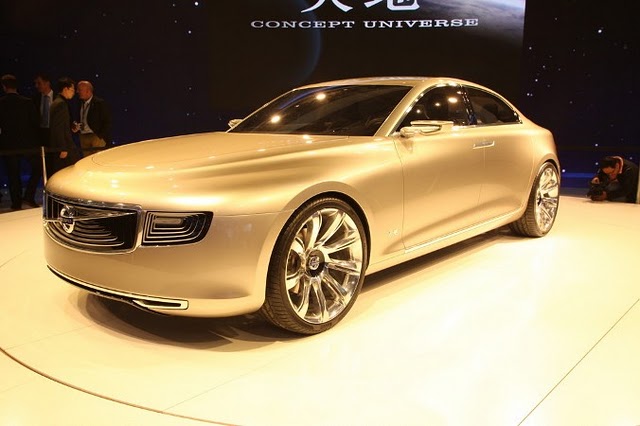
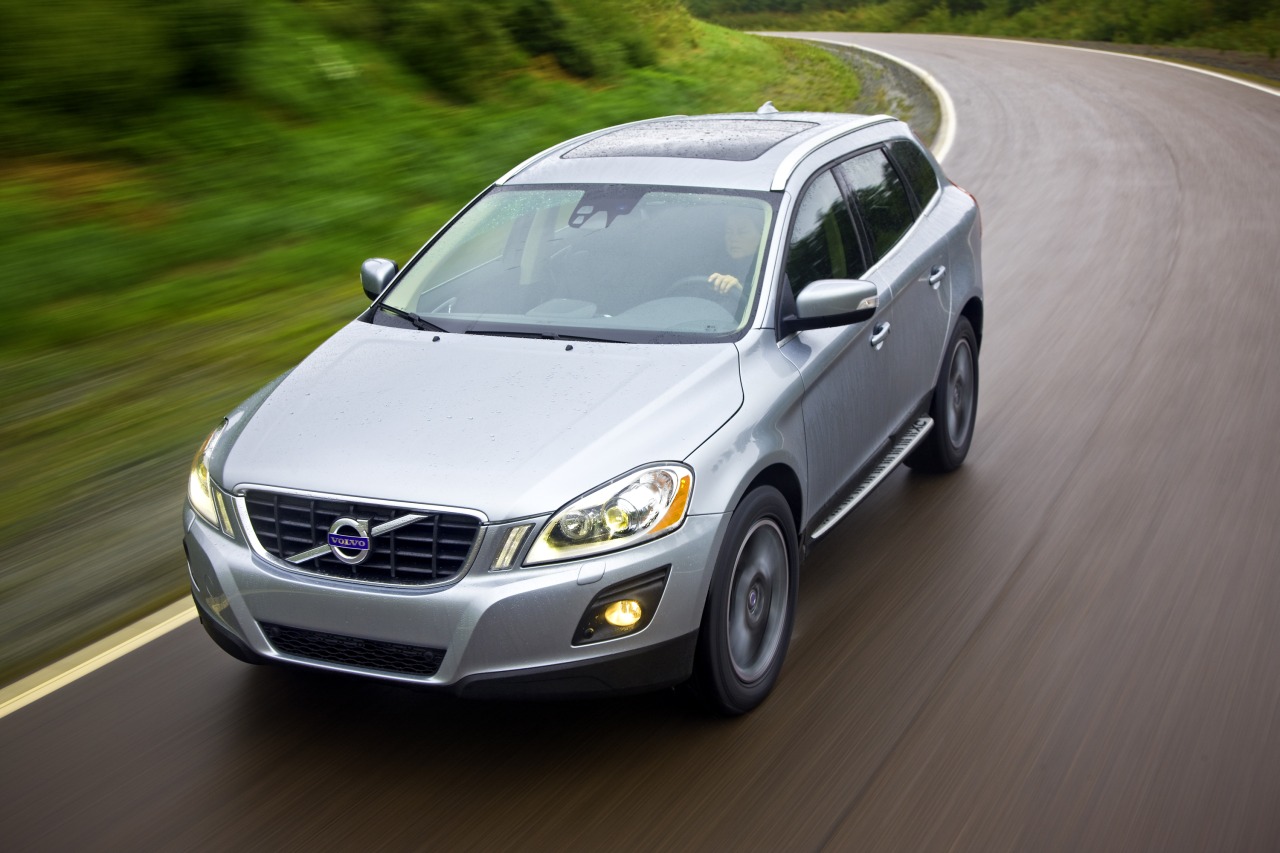
American automakers are streamlining, big time. But we're looking at a Swedish car. In Switzerland. So what does this have to do with Detroit? Well, a lot. But not for long. Volvo's about to change hands from Ford to China's Geely, and (like fellow Swedish automaker Saab now under Spyker's wing) if it's going to survive, it'll need a solid product. This could be it.
Previewed in concept form at the Detroit Auto Show, the production version of the new Volvo S60 made its debut here at the Geneva Motor Show. A few details inevitably had to change on the bumpy road from concept to production, among them the anteater nose of the show car which was thankfully reshaped due to pedestrian impact requirements. And when it comes down to it, that's what Volvo's all about: safety. So it comes as little surprise that the new S60 also debuts the company's new Collision Warning system that will, if necessary, fully engage the brakes.
The S60 makes its debut in T6 guise, packing a turbocharged 3.0-liter inline six with 300 horsepower and 325 lb-ft of torque. More engines will be on offer worldwide once new S60 car reaches the market over the course of the coming months.
[Source: Volvo]
ALL-NEW VOLVO S60 MAKES ITS WORLD DEBUT AT GENEVA MOTOR SHOW
- All-New Volvo S60 makes its international debut at Geneva Motor Show 2010
- New Dynamic chassis tuned for an active drive
- Features the ground-breaking Pedestrian Detection with Full Auto Brake technology
Today, Tuesday 2 March 2010, the all-new Volvo S60 made its international debut at the Geneva Motor Show. It launches into one of the automotive world's most competitive segments backed by an elegant new coupé-like design, dynamic driving characteristics and ground-breaking Pedestrian Detection safety technology.
In its overall shape, the all-new S60 is a coupé; sportier and more distinct than any previous Volvo. In its design, it promises excellent driving characteristics, even before you get behind the wheel. To deliver the highest levels of driving enjoyment, the chassis team have refined every single detail that influences a car's driving properties and fine-tuned the driving experience to offer the most dynamic ride ever seen before on a Volvo.
The all-new S60 range will be available from launch with a choice of two diesels and one petrol engine, including an uprated high-performance 3.0-litre T6 petrol version with 304bhp, a 2.4-litre 205bhp D5 and a 2.0-litre 163bhp D3 powerplant. A DRIVe version powered by a 1.6-litre diesel engine with CO2 emissions of approximately 115g/km and fuel economy of up to 65.7mpg (combined cycle, preliminary figure) will join the range later in 2011.
DESIGN
In its overall shape, the all-new S60 is a four-door coupé - sportier and more distinct than any previous Volvo.
The C-pillar of the all-new S60 stretches all the way to the tail lamps – and the slim coupé -like roof line is accompanied by a new contour on the shoulders on either side of the lower body. This creates a gentle double wave in the line from the headlamps at the front to the tail lamps at the rear.
The S60's athletic stance is accentuated by a sculpted bonnet and short overhangs front and rear, plus what Volvo's design team calls the "racetrack" design. The car's lines do not end abruptly but instead continue to flow organically, echoing the smooth shapes of the racetrack.
This sporty appearance can be further enhanced with an exterior styling kit that incorporates front and rear skid plates, two frames in the lower valence, side scuff plates, exhaust tailpipe finishers and 18-inch alloy wheels.
Volvo's designers have also used LED (Light Emitting Diode) technology to create distinctive, signature lights at the front and rear that make the car clearly identifiable as an S60, even in the dark.
The all-new Volvo S60 is being introduced with a range of exterior colours including two new shades: Vibrant Copper and Electrum Gold.
NEW DYNAMIC CHASSIS
The new Volvo S60 is the most sporting Volvo ever built and during the development process, the chassis team refined every single detail to fine tune the driving experience. The result of their labours is a newly-developed Dynamic chassis, standard on every new Volvo S60.
The steering gear ratio is 10 per cent faster than in previous models to give enhanced steering feel and sharper response. The steering column's thicker tubing and stiffer bushes have increased torsional rigidity by 100 per cent. This also contributes to the increased feeling of direct contact with the wheels and the road.
The front spring struts have thicker pistons compared with the sports chassis in the Volvo S80. The resultant 47 per cent increase of stiffness means that the body structure is better able to absorb lateral loads. The springs themselves are shorter and stiffer than before and the Eigen frequency has increased by 10 per cent. At the front, spring strut mounting stiffness has increased by 50 per cent. The front and rear subframe bushes are up to twice as stiff compared with previous models. The link arm bushings have also been optimised for sporty driving and full control.
The damper mountings at the rear are made of PUR (polyurethane) instead of rubber to provide better balance between comfort and dynamic control.
Stefan Sällqvist, responsible for the S60 chassis development explained: "We spent many weeks fine-tuning the dampers out in the English countryside. We drove on old Roman roads that have only ever received a few layers of tarmac over the centuries – a perfect environment for finding the right damping qualities."
Advanced Stability Control
The Dynamic Stability and Traction Control (DSTC) in the all-new S60 has a number of sophisticated features to improve driving pleasure and safety. The S60 is the first saloon on the market with Volvo's Advanced Stability Control. With a new roll sensor, it's possible to identify any skidding tendency at a very early stage. This means that the anti-skid system can step in earlier and with greater precision. Advanced Stability Control is a great asset in dynamic driving that involves considerable lateral forces.
New Corner Traction Control for smoother curves
The dynamic new chassis is backed up by a range of electronic systems that further sharpen the sporty driving experience. Corner Traction Control is a new feature that uses torque vectoring so the car takes corners more smoothly. This technology is a further refinement of the DSTC system. When taking a curve, the car's inner driven wheel is braked at the same time as more power is transmitted to the outer driven wheel. This allows the driver to take the corner more tightly while reducing any tendency to understeer.
Advanced, integrated braking functions
A highly advanced braking system is an important part of the dynamic driving properties of the all-new S60. A number of features interact to provide the shortest possible stopping distance in all scenarios. Technology includes:
- Ready Alert Brakes can predict when emergency braking is needed. The brake calipers are applied lightly to the brake discs even before the driver presses the brake pedal.
- Hydraulic Brake Assist helps the driver brake in the shortest possible distance. In an emergency situation where the driver does not press the brake pedal fast or hard enough, Hydraulic Brake Assist can help utilise the ABS system optimally and thus shorten the overall braking distance.
- Optimised Hydraulic Brakes is a system that amplifies braking ability during firm braking by using hydraulics to compensate for low vacuum pressure in the brake servo.
- Fading Brake Support uses the hydraulic system to gradually build up brake pressure during long, hard braking. This helps reduce the risk of brake fade and maintains pedal feel.
- The all-new S60 is equipped with an Electronic Parking Brakeas standard.
FOUR-C as an option
All variants of the new S60 can be specified with the FOUR-C active chassis, which has been modified and refined for better control and comfort. This is an advanced, self-adjusting chassis system that uses a number of sensors to continuously monitor the car's behaviour. In mere fractions of a second, the dampers are adjusted to suit the current driving situation.
With three alternative chassis settings, all it takes is for the driver to press a button to alter the car's character: Comfort, Sport or Advanced.
ENGINE RANGE
At launch, the S60 range will be available with a choice of two diesels and one petrol engine. All the engines have been developed to meet the highest demands on sporty, dynamic driving with competitive fuel consumption.
All-new Volvo S60 engine programme from start of production:
Petrol engines Displacement Configuration Output Torque
T6 AWD 3.0 6-cyl in-line 304 bhp 440 Nm
Diesel engines Displacement Configuration Output Torque
D5 2.4 5-cyl in-line 205 bhp 420 Nm
D3 2.0 5-cyl in-line 163 bhp 400 Nm
Two five-cylinder turbo diesels
The high-performance twin turbo D5 produces 205 horsepower and 420Nm of torque. Acceleration from 0-62mph takes 7.8 seconds (manual and automatic) and top speed is 146mph (manual) and 143mph (automatic). In the most recent D5 version, introduced in spring 2009, the performance and driveability requirements have been met by fitting two turbochargers of different sizes, one taking over from the other and providing added power within a broader rev range. The result is alert response and rapid acceleration at all speeds, with seamless transfers in the turbo rev range between the two turbochargers. The complementary properties of the two turbos combine high performance with lower fuel consumption of 47.9mpg (EU Combined, preliminary figure).
Advanced fuel injection technology using piezoelectric fuel valves gives exact distribution of fuel in the combustion chamber, with efficient combustion and low emissions as a result.
Smaller displacement lowers fuel consumption
In addition there is the newly-developed 2.0-litre D3 engine producing 163hp and 400Nm of torque. Acceleration from 0-62mph takes 9.2 seconds (manual and automatic) and top speed is 137mph (manual) and 134 mph (automatic).
The new five-cylinder 2.0D is, in principle, the same engine as the present 2.4D, but cylinder capacity has been reduced with a shorter stroke to optimise fuel consumption. With a manual gearbox fuel consumption is now up to 54.3mpg (EU Combined, preliminary figure).
The engine has been optimised to offer reduced fuel consumption and the injection system has a different type of piezoelectrical fuel valve compared with the D5 engine. These valves keep fuel consumption to a minimum thanks to exceptionally fast and precise injection pulses under high pressure. This results in far more efficient combustion.
In order to give the car better driving properties, the turbocharger has been fine-tuned for high torque from low revs.
Both turbodiesels are available with six-speed manual gearbox as standard or an optional six-speed automatic transmission. A maintenance-free particulate filter that traps about 95 percent of the soot particles is fitted as standard in both engines.
High-performance T6 petrol engine
The 3.0-litre T6 petrol engine generates 304 hp and 440 Nm of torque, enhancing acceleration and smooth progress on the road. Acceleration from 0-62 mph takes 6.5 seconds and top speed is 155 mph. Volvo Cars' engine specialists have succeeded in cutting fuel consumption by about 10 per cent to 27.7 mpg (EU Combined, preliminary figure).
The engine's power is delivered to the wheels via Volvo's second-generation six-speed automatic Geartronic transmission. New valves and lower friction mean faster gear changes than before. AWD (All Wheel Drive) is standard on the T6.
Engines to be added during first year of production:
Petrol engines Displacement Configuration Output Torque
T5 2.0 4-cyl in-line 240 bhp 320 Nm
T4 1.6 4 cyl in-line 180 bhp 240 Nm
T3 1.6 4-cyl in-line 150 bhp 240 Nm
Diesel engines Displacement Configuration Output Torque
1.6 D DRIVe 1.6 4-cyl in-line 115 bhp 270 Nm
DRIVe diesel below 115 g/km
During the first year of production a DRIVe version of the all-new S60 will be introduced, featuring a new 1.6-litre diesel engine. Fuel consumption will be an impressive 65.7mpg (EU Combined, preliminary figure), corresponding to CO2 emissions approximately below 115 g/km. The uprated engine produces 115 hp and 270 Nm of torque, and will only be available with a six-speed manual gearbox.
Later during the first year of production, the all-new S60 will also become available with a 2.0 GTDi variant (T5) producing 240 hp and torque of 320 Nm. Furthermore, there will be a 1.6-litre GTDi engine available in two versions: 180 hp (T4) and 150 hp (T3) with torque of 240 Nm.
All the GTDi engines will be available in combination with Volvo's optional automatic six-speed Powershift transmission or a six-speed manual gearbox as standard. The Powershift concept works like two parallel manual gearboxes with separate clutches, giving quick and fuel-saving gearchanges.
Further information on these engines will be communicated at a later date.
PEDESTRIAN DETECTION WITH FULL AUTO BRAKE
The all-new Volvo S60 features the ground breaking Pedestrian Detection with Full Auto Brake system. Pedestrian Detection consists of a newly developed radar unit integrated into the car's grille, a camera fitted in front of the interior rear-view mirror, and a central control unit. The radar's task is to detect any object in front of the car and to determine the distance to it. The camera determines what type of object it is.
The full auto brake part of the technology also responds to vehicles in front that are at a standstill or that are moving in the same direction as the car fitted with the system.
The newly developed dual-mode radar's much wider field of vision ensures that pedestrians about to step into the roadway can be detected early on. The camera has higher resolution than the previous-generation auto brake which makes it possible to detect the pedestrian's pattern of movement.
"The auto-brake system requires that the object is confirmed by both the radar and the camera. Thanks to the advanced sensor technology used, it is now possible to increase to full braking power," explains Thomas Broberg, Senior Safety Advisor at Volvo Cars.
"Detecting pedestrians with sufficiently high reliability has been a complex challenge. Our innovative technology is programmed to trace a pedestrian's pattern of movement and also to calculate whether he or she is likely to step into the road in front of the car. The system can detect pedestrians who are 80 cm tall and upwards, that is to say including children."
New technology permits full braking force
In an emergency situation the driver first receives an audible warning combined with a flashing light in the windscreen's head-up display. In order to generate an immediate, intuitive reaction, this warning resembles a brake light. At the same time, the car's brakes are pre-charged. If the driver does not react to the warning and an accident is imminent, full braking power is automatically applied.
This technology has the same limitations as the human eye, and just like us it "sees" less well in the dark and in poor weather.
Pedestrian Detection with Full Auto Brake can avoid a collision with a pedestrian at speeds of up to 21mph if the driver does not react in time. At higher speeds, the focus is on reducing the car's speed as much as possible prior to the impact. The speed reduction is up to 21mph.
Statistics reveal that the car's speed has considerable importance for the outcome of the accident. A lower speed of impact means that the risk of serious injury is significantly reduced. For instance, if speed is cut from 30mph to 15mph, Pedestrian Detection with full auto brake is expected to reduce the fatality risk by as much as 20 per cent and in certain cases by up to 85 per cent.
City Safety
The all-new Volvo S60 also features City Safety as standard, as seen on its bigger brother - the XC60. The system can reduce or even entirely avoid low-speed rear-end impacts at speeds up to 18mph.
Additional safety systems available:
- Driver Alert Control (DAC). A unique technology to alert tired and distracted drivers. This function monitors the car's progress between the lane markers and warns the driver if his or her driving pattern changes in a random or uncontrolled way.
- Blind Spot Information System (BLIS) helps detect vehicles in the rear blind spot on both sides of the car. A warning lamp beside the relevant door mirror comes on to alert the driver to the danger.
- Active Bi-Xenon Lights are articulated headlights that follow the curve of the road. For best possibility illumination when driving in the dark on twisting roads.
- Lane Departure Warning alerts the driver if the car runs across the lane markers without the turn indicator being used.
- Advanced Side Impact Protection System
- Seat-mounted side airbags
- Improved Inflatable Curtains
- Whiplash Protection System
INSIDE THE CABIN
Drivers and passengers can experience the agile new chassis in complete comfort thanks to the spacious and refined cabin. The interior of the new S60 has been designed with driver-oriented details, but is still a five-seater car offering comfortable space for all its occupants. The sculpted outer rear seats give the passenger in the middle welcome side support. Knee space in the rear seat has increased by 30 mm compared with the previous-generation S60.
The designers also took the exterior's racetrack inspiration into the interior of the car. "Every detail looks like it's in motion. All the lines 'embrace' the driver's cockpit. The instruments and centre stack are angled towards the driver to create a sensation of focus and control. The new dynamic three-spoke steering wheel and the new sports seats with extra side supports are standard. There isn't any compromise anywhere in the dynamic approach we adopted from the very beginning," says Jonathan Disley, head of interior design in the all-new Volvo S60.
Easily accessible storage space is another important part of interior comfort and convenience. The all-new Volvo S60 has a storage compartment behind the centre stack and another in the centre console armrest, while in the door pockets there is space for books, maps, soft-drink bottles and cans. Both the front and rear seat occupants have seat pockets within easy reach. The rear seat splits 40/60 and the boot opening has been made 100 mm wider than in the previous-generation S60.
Beige and black are the main colours of the upholstery range, which is spiced up with the new highlight shade of Beechwood Brown – a tan leather upholstery that traces its proud roots back to classic Volvo models such as the P1800 ES and 164.
Clean Zone Interior gives enhanced comfort
The Electronic Climate Control system, (ECC), offers automatic control of both temperature and ventilation. The all-new Volvo S60 can be equipped with IAQS (Interior Air Quality System) which prevents particles and unpleasant odours from entering the cabin. To offer highly-sensitive passengers even better climate comfort, the system has also been equipped with Clean Zone Interior, a system based on ECC and IAQS. When the car is unlocked using the remote control, the passenger compartment is automatically ventilated if the outdoor temperature exceeds 10 degrees Celsius.
The all-new Volvo S60 also features:
- Optional Adaptive Cruise Control (ACC) with Queue Assist, automatically maintains a set gap to the vehicle in front and operates at speeds below 18mph, all the way down to standstill.
- Optional front and rear parking sensors and a rear Park Assist camera.
- Optional camera in the front grille with a 180-degree field of vision that can 'see around the corner' to help drivers negotiate blind exits and park with greater safety.
New Infotainment system
The all-new S60 also gets a new Infotainment system that integrates information from the audio unit, navigation system, mobile phone and other functions into a five- or seven-inch colour screen in the upper part of the centre console. The screen is in a high position to make it easy for the driver to keep their eyes on the road.
All the functions can be controlled from the steering wheel or via controls located directly below the colour screen. In addition there is a separate remote control for passengers to use. Integrated navigation with voice control is available as an option, as is the possibility of using Bluetooth to connect the driver's own mobile phone to the car's infotainment system.
One of the first cars with MultEQ from Audyssey Laboratories
The all-new Volvo S60 is one of the first cars in the world to use Audyssey Laboratories MultEQ technology, the standard for room equalization in the home and professional theatre markets.
MultEQ removes distortion caused by the cabin's acoustics enabling crisp, clear sound for everyone in the car.
In addition to the top-of-the line Premium Sound, which comes with a seven-inch screen, the all-new Volvo S60 is available with a choice of three other audio systems:
- Performance – with a 4x20 W amplifier, six loudspeakers and a five-inch screen.
- High Performance – with a 4x40 W amplifier and eight loudspeakers. This system also comes with a five-inch screen.
- High Performance Multimedia – with a 4x40 W amplifier and eight loudspeakers. This level is combined with the optional navigation system and the larger seven-inch screen.
GLOBAL SALES
The first-generation Volvo S60 was launched in 2000. It soon became Volvo Cars' most popular model, enjoying worldwide acclaim and peak sales of 110,000 cars in 2002. In total, there are about one million S60s on roads the world over today.
The initial annual global target for the all-new Volvo S60 is 90,000 cars and the car's customer base is spread unusually uniformly throughout the world. Europe (including Russia), North America, and the rest of the world will each account for about one-third of total sales. The five largest single markets will be the UK, USA, China, Russia and Sweden. The all-new Volvo S60 will be built at the Volvo Cars factory in Ghent, Belgium and first cars will be delivered to customers in early summer 2010.